
Insights

From 21 October to 1 November delegates from governments, corporations, industry and NGOs will gather in Cali, Colombia to discuss the mobilisation of resources to support global action on biodiversity.
The Convention on Biological Diversity (CBD) Conference of Parties, or Biodiversity COP, was launched at the Earth Summit in 1992 as a pillar of the Rio Conventions on biodiversity, climate and desertification. You’ll likely know its more prolific brother, UNFCCC or climate COP, with COP29 set for November in Baku, Azerbaijan.
The key objectives of biodiversity COP are:
- Conservation of biological diversity
- Sustainable use of nature’s components, and
- The fair and equitable sharing of the benefits arising from commercial and other utilization of genetic resources.
These principles apply to all ecosystems, species and genetic resources.
Notably, the Biodiversity COP hosts a conference every two years rather than annually, which is where the discrepancy in numbering comes from.
Nature’s ‘Paris moment’
The last conference (COP15, held in Montreal in December 2022) founded the Kunming-Montreal Global Biodiversity Framework, also known as the GBF or Biodiversity Plan. Agreement of the GBF stands alongside the Paris Agreement in terms of its significance in achieving international consensus on the urgency needed to protect and restore biodiversity.
The GBF agreed a set of four long-term goals for 2050 on biodiversity loss; ecosystem maintenance for sustainable development; use of genetic resources and traditional knowledge; and capacity building through financial support and scientific cooperation.
It also has 23 targets pinned to a 2030 deadline, the most famous of which is the 30x30 target. This a commitment to conserve 30% of land, water and seas by 2030 through the establishment of protected areas and conservation measures that recognise indigenous and traditional territories.
COP 16 will chart nations’ progress on these commitments since 2022, looking in particular at the National Biodiversity Strategies and Action Plans (NBSAP) that countries are expected to have published by the start of the conference. Key issues on the agenda include:
- Operationalisation of the monitoring framework for the 23 targets to support national reporting
- Mobilisation of finance necessary for implementation, particularly on Target 19 which pins a $20 billion per year target for public finance by 2025
- Finalise the mechanism to equitably share digital sequence information on genetic resources
IIGCC, nature and COP16
For investors, biodiversity COP is a crucial platform for coordinated public and private action on nature and biodiversity. Our work on nature and climate increasingly overlaps across these two core issues, supporting the adage that ‘there’s no net zero without nature.’
The goals and targets outlined by the GBF are the building blocks for global policy on biodiversity and have clear implications for the private sector, our work, and our investor members.
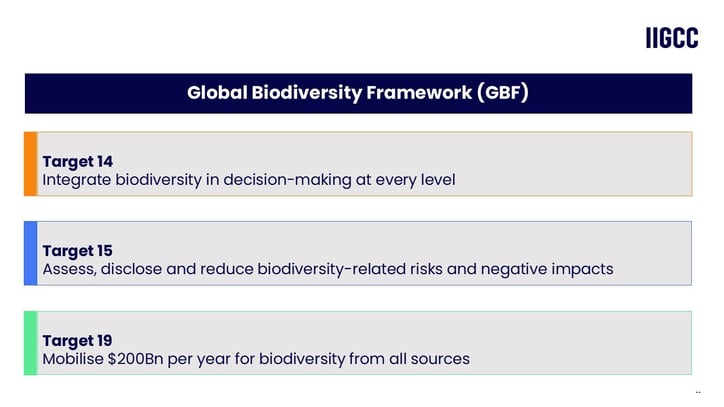
Our top three asks for the presidency and governments:
Target 14: Implement ambitious NBSAPs that support the targets in their NDCs, per the Global Biodiversity Framework
Target 15: Strengthen nature-related disclosures across the financial system by encouraging corporate reporting aligned with the Taskforce on Nature-Related Disclosures
Target 19: Establish specific policies and regulations that help create an enabling environment (e.g. removing harmful subsidies, guards against deforestation)
These targets look to develop policies and regulation to incentivise business action to protect and restore biodiversity. The next step will be implementation through domestic policies, such as the EU Deforestation Regulation, to address specific regional issues.
Addressing this gap between global and national goals will give the private sector more guidance to formulate action on the ground. We have structured our work on nature to align with these targets.
At COP15 in 2022, for example, we co-launched the Nature Action 100 initiative alongside our network partners. Today it supports corporate engagement for over 220 institutional investors, representing nearly $30 trillion in assets under management or advice globally.
At COP16, Nature Action 100 will announce its first set of benchmark results for companies measured through their disclosures.
More broadly, we are a founding partner of the Investor Agenda, which recently released its Global Investor Statement (GIS). Signed by more than 500 investors representing USD $29 trillion in assets under management, it calls on governments to improve and expand their policies on climate and nature.
Our work on deforestation, including taking on the role of Secretariat of the Finance Sector Deforestation Action, further aligns with the deforestation goals as part of recent COP outputs.
Looking forward to COP 30
Despite their framing as separate conferences, the climate and biodiversity crises are inextricably linked. Changes in climate and rising global temperatures are driving critical biodiversity loss. As ecosystems are impaired and species struggle to adapt and survive on a changing planet, the world loses an invaluable resource in the fight against climate change.
Biodiverse ecosystems play a vital role in global climate cycles. Healthy ecosystems like forests, wetlands and coral reefs can help sequester carbon emissions and keep it locked away in carbon sinks, as well as increasing resilience to physical climate risks such as flooding and extreme temperatures.
Approaching these pillars in tandem is a strategy outlined in a joint statement from the UNFCCC COP28 and COP30 presidencies, the CBD COP15 and COP16 presidencies and UN Convention to Combat Desertification (UNCCD) COP15 presidency.
COP30, hosted in Belem, Brazil, will be a key opportunity to look holistically at the nexus between nature and climate. Ten years on from Paris, it is a key milestone marks the deadline for countries to submit their updated Nationally Determined Contributions (NDCs) for climate action. There are increasing calls for nature to be included as a consideration in NDCs, providing another opportunity to push for alignment of climate and nature strategies.
Brazil is at the forefront of biodiversity discussions on the global stage. It is home to 60% of the Amazon rainforest, which - alongside its great cultural, economic and social significance for the region - plays a crucial role in climate systems, biodiversity and nature. It’s stewardship will undoubtedly play a central role in climate discussions on the road to COP30.
It’s therefore clear that the outcome from Cali is set to have wider implications for climate and nature policies alike.
If you’d like to take part in our working groups and help shape the outputs of our resources, why not get in touch today to learn more about becoming a part of IIGCC?